
Shavige / Shevai / Idiyappam

Shavige
Lately, for some unknown reason, I haven't been able to blog about new recipes. But today, I managed to shrug off my laziness and cook something different. So, here I am with gluten free 
Indian Rice Noodles or Vermicelli. In Konkani, we call this as Shevai and it is served with both sweet and savory accompaniments. Many of you might know this as Idiyappam or Shavige.
Traditionally, Shevai is made by a lengthy process of soaking rice, grinding and stuff. As you know me, I look for the easier way. But, its equally delicious.

Ingredients:
Rice Flour - 1 cup
Water - 1 cup
Salt
Oil

How to make Rice Shevai / Idiyappam:
  • In a mixing bowl, add rice flour and salt. Mix well.
  • Heat 1 cup water in a small sauce pan. Turn off the heat when water starts boiling. Pour the hot water to the bowl and mix with a spoon.
  • When it turns cold enough to handle, knead it well to make a soft dough. Divide the dough into 2 balls.
Shevai Maker
  • Grease the idli plates with cooking spray or oil. Also, grease the inner part of the shevai maker with few drops of oil. Place the shevai plate with small holes and put one dough ball. Close it with the lid.
  • Turn the handle of the shevai maker and let the shevai fall on the greased idli plates. Repeat the same for the rest of the dough.
  • Steam the shevai in an idli cooker for 12 - 15 minutes. In case, you are using a pressure cooker, remove the weight/whistle while steaming.
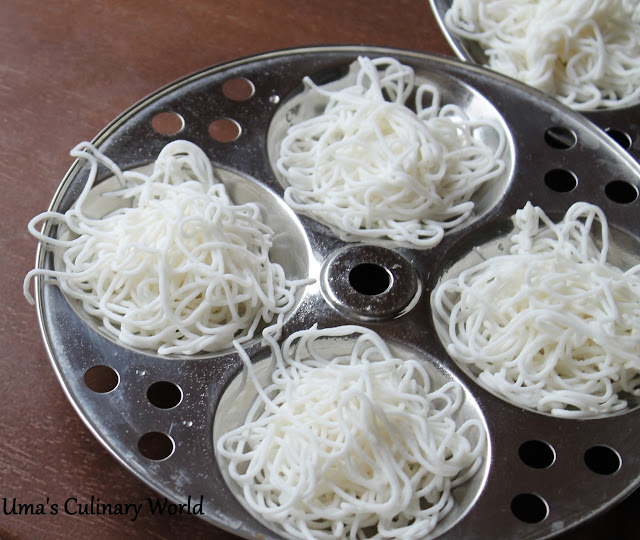
    Steamed Rice Shavige
Serve steamed Shevai with a Coconut Chutney or sweetened Coconut Milk. For sweetened coconut milk, mix coconut milk, grated jaggery and cardamom powder. Some like to add thin slices of banana with sweetened coconut milk as well.

Comments

  1. Lovely looking idiyappams. Excellent preparation.
    Deepa

    ReplyDelete
  2. delicious idiyappam wonderfully done

    ReplyDelete
  3. i love shevai,nice idea to make it this way,seems easy and looks delicious

    ReplyDelete
  4. Grogeous beauties, loved its soft texture.

    ReplyDelete
  5. Idiyappams with coconut milk, i can die for.

    ReplyDelete

Post a Comment

Comments, Suggestions and Feedback are welcome.
Any comment with a Link/URL or any kind of promotion will not be published.

Popular posts from this blog

Indian Dal / Lentils

Lentils, known as Dal are a staple in an Indian diet, especially vegetarian. For me, dal is comfort food. 5 different dal varieties - Toor, Moong, Chana, Masoor and Urad are commonly used in Indian sweet and savory delicacies. You can cook dal with just one kind or a mix of two or more. I generally cook dal with 1:1 Toor and Moong dals. But then, we like Panchmel or Panchratna Dal too, which is made of all five. Most dal recipes have Toor dal as the primary ingredient. It is also known as Toovar or Arhar dal or Split Pigeon Peas . Some of our family favorite dal recipes are Dalitoy (Konkani Dal)  Tadka Dal Among all lentils, moong dal and masoor dal take lesser time to cook. Moong dal is also known as Split Green Gram or Split Mung Bean . Moong dal is also used in making sweet dishes like Mung Dal Kheer  Mung Dal Puranpoli Chana dal is also known as Split Bengal Gram or Split Chickpeas . Chana Dal takes a little more time to cook as compared to toor dal....

Naval Kol Bhaji / Kohlrabi Stir-fry

Green Kohlrabi called as Navalkol in Marathi and Navilkosu in Kannada, belongs to the cabbage family.  My Mom used to make this stir fry very often.  Just like cabbage, this vegetable in available in two colors - green and purple.  I was quite hesitant about the purple one, as I haven't seen that back in India.  Anyway, I picked the green bulbs and Navalkohl Bhaji with Chana Dal was part of our healthy vegetarian meal today.

Surti Val Papdi Bhaji

My Mom used to make Val Papdi Bhaji in a simple way with few ingredients. This is the first time I gave it a try here in my US kitchen. This stir fry does require little more oil, as no water is added for cooking. Dal Rice tastes great with this sauteed Papdi.  I tried this Bhaji once with frozen Surti Papdi and I was not happy with the result. I prefer fresh Papdi for this recipe, which I can only find in the local Indian store. I am not sure if Val Papdi is called as Navy Bean or Fava Bean in English.